Give every client their own command center.
Agencies don't usually lose clients because the marketing stopped working. They lose them because the client stopped seeing it working. A portal fixes the thing that actually causes churn: silence.
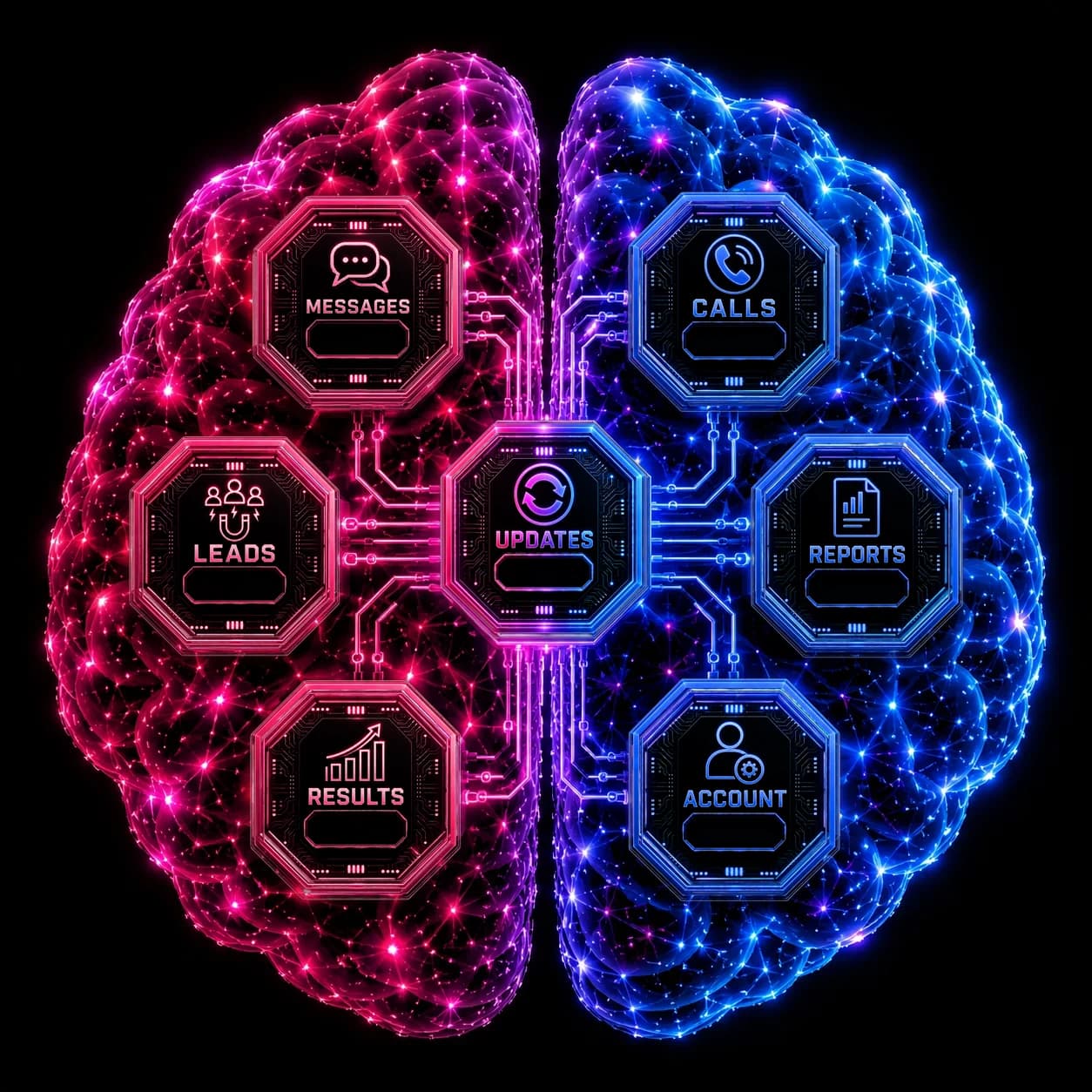
Six things, one screen.
Your client isn't a software user. They're a roofer with a phone in a truck. So the portal opens on one screen with six places to go and a live count on each — no menus to learn, no training call.
- Messages — their thread with your team.
- Leads — what came in, and who's qualified.
- Results — pipeline and revenue, in their language.
- Calls — appointments booked for them.
- Reports — the numbers, when they want to dig.
- Account — approvals, invoices, settings.
One thread instead of five channels.
Right now your client conversations are scattered across personal texts, a Facebook message, an email thread, and a phone call nobody wrote down. When someone on your team is off, that context is gone.
In the portal, messaging is one thread per client — and it opens right on their home screen, not buried in a section. They tap Messages, the chat slides up, they type, done. Your team sees it in the Operations and Client Success brains with the full history attached.
- Nothing gets lost when someone's away — the thread belongs to the account, not a person's phone.
- Replies are pushed to their phone, so a question doesn't sit unanswered for a day.
- Tapping the notification opens the message — not a login screen, not a menu.
The two taps that make ROI real.
You can't prove return on ad spend without knowing what happened after the appointment. So the portal asks — gently, and one lead at a time.
After an appointment, the client gets a check-in: did they show? Later, if it went ahead: did the job close, and for how much? Each lead is its own small chat box with one-tap answers and a text field — so a client with three check-ins sees three tidy cards, answers each, and each disappears when it's handled. Nothing merges into one long thread they'd have to scroll.
That's the missing link. Once show-rate and job value flow back in, your reporting stops being “we generated 40 leads” and starts being “we generated $62,000 in booked work at a cost of $4,100” — the only sentence that matters at renewal.
Why one tap, not a form
Every extra field is a client who doesn't answer. The check-in is a button in a portal they already have open — which is why the data actually comes back, and your ROI numbers stay honest.
It doesn't look like our software.
The portal carries your client's name and colours — “Surewest Roofing Portal”, not a generic dashboard. On a white-label plan it carries your agency's brand instead of ours, so the product your client uses every week is yours.
- Installable as an app. They add it to their home screen and it stays logged in — it behaves like an app because, to them, it is one.
- Push notifications for new leads, qualified leads, and messages — with per-client control over which ones they want.
- Password-protected per client, so a forwarded link isn't an open door.
The strategic point: a client with your app on their home screen, showing them leads every week, is a client who does not take a competitor's cold call seriously.
What the agency gets out of it.
Fewer “just checking in” calls
Clients who can see their leads stop asking whether anything is happening. The account manager's week gets quieter and more useful.
Reporting that writes itself
Show-rate and closed revenue come from the client's own taps, so the monthly report is assembled from real outcomes instead of platform metrics.
Churn you can see coming
A client who stops opening the portal is a signal. The Client Success brain surfaces the drift while there's still time to make a call.
Common questions.
Will my clients actually use it?
Can I white-label it?
Is each client's data separate?
Do I have to use the check-ins?
Show a client what they'd see.
We'll set up a live portal on one of your accounts during the demo.
Book a demo →